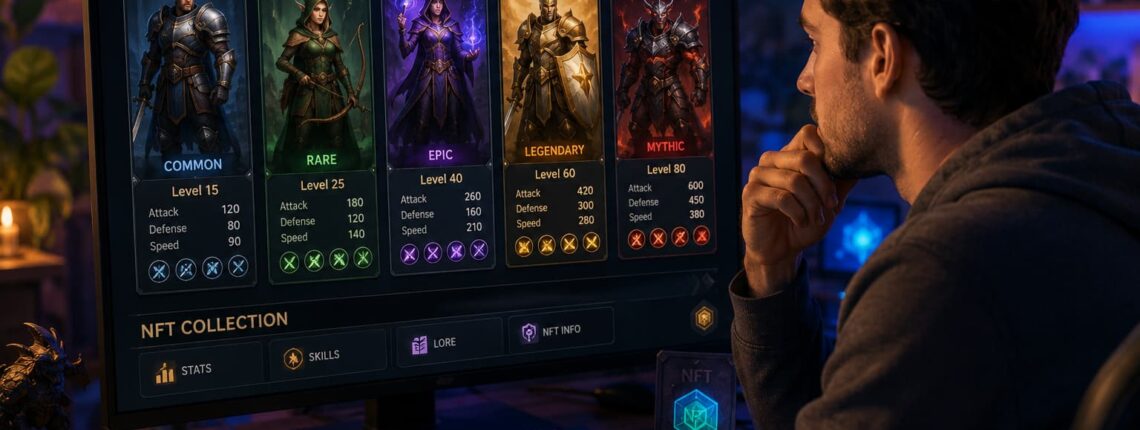
In NFT games, rarity is one of the first things players notice. A character may be labeled common, rare, epic, legendary, mythic, or placed in another special category. The visual design may look more impressive. The supply may be limited. The marketplace price may be higher. For many new players, this creates a simple assumption: if a character is rare, it must be better.
That assumption is not always correct. Rarity can matter, but it does not automatically mean that a character is useful in real gameplay. A rare NFT character can be valuable as a collectible, but weak in a specific team. A more common character can be cheaper, easier to upgrade, and more effective in daily play. The real question is not only how rare the character is. The real question is what the character actually does inside the game.
NFT games often combine two types of value. The first is market value. This is influenced by rarity, supply, demand, visual appeal, collection status, early ownership, and speculation. The second is gameplay value. This depends on abilities, stats, role, balance, upgrade cost, team synergy, and usefulness in different game modes. These two values can overlap, but they are not the same.
A rare character usually gets attention because it is limited. Players may believe that limited supply creates long-term value. In some cases, that is true. If a game has an active player base and the character is both rare and powerful, demand can stay strong. But if the character is rare only because few copies exist, and it does not perform well in gameplay, the practical value may be lower than expected.
This is especially important after the early play-to-earn hype. In the first wave of NFT gaming, many players focused heavily on asset prices, rewards, and resale potential. Today, players are more careful. They want to know whether a character helps them win battles, complete missions, climb rankings, farm rewards, or enjoy the game. A rare NFT that looks impressive but does not improve performance may become a status item rather than a useful tool.
The first thing to check is the character’s role. In many NFT games, characters are not meant to be compared only by rarity. They may have different jobs: attacker, defender, healer, support, tank, speed unit, control unit, or resource farmer. A rare attacker may be powerful, but useless if the player already has enough damage and needs support. A less rare healer may bring more value to the team because it solves a real gameplay problem.
Team synergy is often more important than rarity. A character may become strong only when combined with the right weapon, class, element, faction, skill set, or companion. If the character’s abilities do not work well with the rest of the team, rarity will not save it. In strategy games, the best unit is not always the rarest one. It is the one that fits the player’s setup.
Stats also need careful reading. A rare character may have higher base stats, but the difference may not be large enough to justify the price. Sometimes the advantage appears only after several upgrades. If upgrades are expensive, slow, or require rare materials, the real cost of using the character becomes much higher than the purchase price. A cheaper character with lower upgrade costs may be more efficient over time.
Game mode matters too. A character can be strong in player-versus-environment missions, but weak in player-versus-player battles. Another character may be excellent for farming, but poor in boss fights. Some characters are useful early in the game and lose value later. Others need time and upgrades before they become strong. A player should always ask: where will I actually use this character?
Marketplace listings often make rarity look more important than it is. Sellers naturally highlight rare traits, limited supply, and high category labels. But a buyer should look beyond the rarity badge. The important questions are practical: How often is this character used by active players? Does it appear in strong teams? Is it easy to upgrade? Does it need expensive equipment? Has the game developer recently changed its balance? Could the character be nerfed later?
A nerf is one of the biggest risks in NFT gaming. If a character becomes too strong, developers may reduce its power to protect game balance. This can affect both gameplay value and market price. A player who buys a rare character only because it is currently overpowered may face a sudden drop in usefulness. In traditional games, balance changes affect gameplay. In NFT games, they can also affect asset value.
Liquidity is another factor. A rare character may be expensive, but that does not mean it is easy to sell. If only a small number of players want that type of character, the owner may have to wait a long time for a buyer. A more common but widely used character may have better liquidity because more players understand its value. In practice, liquidity can matter more than rarity when a player wants to change strategy or leave the game.
Players should also separate emotional value from gameplay value. It is perfectly fine to buy a character because it looks great, belongs to a favorite collection, or feels unique. NFT games often include collecting as part of the fun. But players should be honest about why they are buying. If the goal is enjoyment or collection, rarity may be enough. If the goal is performance, rarity must be tested against actual gameplay utility.
For beginners, the safest approach is to avoid buying only the rarest asset available. It is better to study the game first. Watch how experienced players build teams. Check which characters are used in different modes. Compare upgrade paths. Look at recent balance updates. Read community discussions, but do not follow hype blindly. A character that everyone praises today may become less useful after the next update.
A good NFT character purchase usually balances several factors: rarity, role, stats, synergy, upgrade cost, liquidity, and long-term usefulness. None of these should be ignored. Rarity can be a signal, but it should not be treated as proof. The strongest assets are usually those that combine scarcity with real utility.
This is where NFT games become more interesting than simple collecting. A character is not only an image in a wallet. It is part of a system. Its value depends on how the game works, how players compete, how rewards are earned, and how developers maintain balance. The same rarity level can mean very different things in different games.
NFT character rarity still matters. It can influence price, demand, identity, and pride of ownership. But real gameplay value comes from use. A rare character that helps the player win, progress, adapt, and build stronger teams has deeper value than a rare character that only looks impressive on a marketplace page.
In the end, the smart player does not ask only, “How rare is this NFT?” The better question is, “What can this character actually do for me in the game?” That question separates speculation from strategy, and it helps players make better decisions in a market where rarity is visible, but usefulness is not always obvious.